
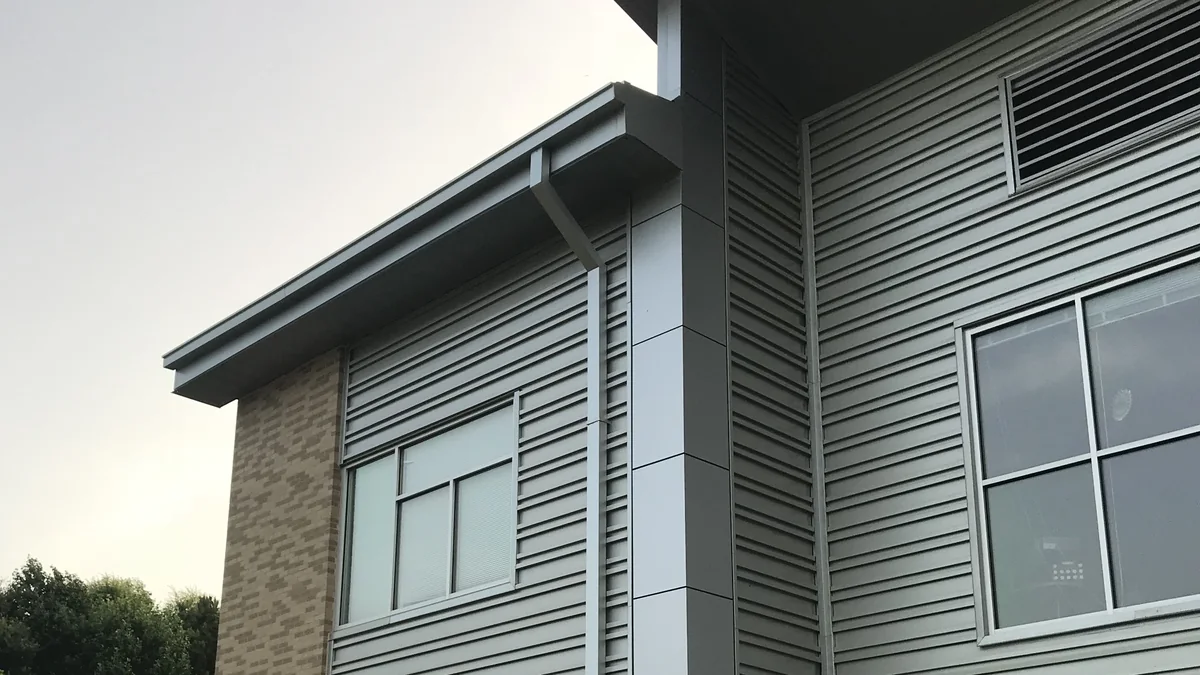
Illustrative drainage photo: Ivangiesen / Wikimedia Commons, CC0. Cropped for layout.

Gutters can overflow even when the visible channel looks clean. Water may be backing up at an outlet or inside a downspout, collecting in a low spot, arriving faster than the system can carry it, or missing the gutter at the roof edge.
The useful question is where the water stops following its intended route: roof, gutter, outlet, downspout, then discharge. Before paying for another cleaning or a larger gutter, ask for an assessment of that whole route.
1. A clean gutter can still have a restricted outlet
A view from the ground cannot establish that the gutter and downspout are clear. Debris may remain at the opening where the gutter feeds the downspout or farther along the enclosed pipe. Clearing the open trough alone does not verify that water can leave it.
GAF explains how leaf accumulation can obstruct drainage and cause water to spill over a gutter. When arranging service, ask whether the scope includes the outlets, downspouts, and confirmation that water reaches the discharge point.
If a downspout connects to a buried pipe, identify where that pipe goes. A gutter cleaning and an underground drainage investigation are different scopes. Ask who will evaluate the downstream connection if the gutter is clear but water still backs up.
2. The gutter may not drain toward its outlet
Gutters rely on their installed slope to move water toward a downspout. A low section or a run that falls away from its outlet can retain water even without a pile of leaves. Cleaning does not correct that geometry.
The Texas General Land Office's drainage-design guidance identifies slope toward the downspout as part of a functioning collection system. Have a contractor check the actual run, its supports, and its connection to the building. The appropriate installation detail depends on the gutter product and property.
Ask the evaluator to show you the affected area and explain whether the proposal involves cleaning, adjusting the run, repairing its support, or replacing a damaged section. A photo of water spilling over the edge alone does not establish which work is needed.
3. The gutter and downspouts need enough capacity
A clear system still has a limit to how much runoff it can handle. The Department of Energy's gutter guidance calls for gutters and downspouts sized for anticipated water loads. Downspout size and spacing affect how quickly water can leave the gutter.
If overflow appears during heavier rain, ask for a capacity review after restrictions and slope have been checked. The review should consider the roof area feeding each run, the expected rainfall load, gutter dimensions, outlet openings, and downspout arrangement. A wider trough by itself does not establish that the rest of the drainage path can handle more water.
Request the reasoning behind any proposed size or outlet change. “Install bigger gutters” is incomplete unless the estimate also explains what will happen at the downspouts and final discharge.
4. Guards and concentrated flow deserve a separate look
Gutter guards do not make every part of the system maintenance-free. Gutterglove's maintenance guidance, for example, calls for routine upkeep and removal of surface debris. Use the instructions for the actual product installed on your home.
If water spills at one inside corner or appears to pass across a guard's surface, describe that location to the evaluator. Gutterglove also provides separate troubleshooting for overspilling inside corners, showing why a localized flow problem may need more than a general cleaning recommendation.
Ask whether the issue is surface debris, guard installation, or the way runoff enters that section. A guard upgrade should be tied to an observed condition and compatible installation details.
5. Water behind a gutter may need a roof-edge inspection
Water pouring over the front lip, dripping through a joint, and running down the wall behind the gutter are different observations. Try to identify which one you see from a safe location.
GAF's flashing bulletin explains that roof-edge and other metal flashings direct water toward gutters and away from the structure. When water appears behind a gutter, ask for an assessment of the roof edge, flashing, gutter placement, and attachment rather than assuming the trough has filled up.
Our asphalt roofing system guide explains how these components fit together. If the problem began after strong winds, share that timing and any observations from our wind-damage guide; timing alone does not prove storm damage.
What to record before requesting help
Observe from indoors or a safe ground-level location. Leave ladders, roof access, and elevated flow testing to a qualified professional. A short video can be useful when it shows where water first leaves the intended path.
- Location: identify the gutter run, corner, joint, or downspout involved.
- Timing: note whether it happens in ordinary rain, heavier rain, or after a recent change.
- Route: record whether water crosses the front edge, appears behind it, or backs up near a connection.
- History: include the last cleaning, what was included, and any gutter, roof, or drainage work.
Also note where discharged water goes. DOE's guidance emphasizes carrying runoff away from the foundation; an open downspout is only part of the job if water then collects beside the house. Have the final drainage arrangement evaluated for the property.
For broader seasonal upkeep, use our winter roof and gutter preparation checklist. For a recurring overflow problem, ask for written findings and a scope that identifies the cause being addressed, the proposed correction, and how drainage will be checked afterward.
Discuss your gutter concerns with AMP
For homeowners in Chesterfield and Greater St. Louis, AMP can discuss gutter repair and replacement options and related roof concerns. Contact the team with your address, the overflow location, and any safe photos or video. The team can confirm service and scheduling for your property.
Sources
- DOE Building America: Gutters and Downspouts
- Texas General Land Office: Drainage Design, Rainwater Harvesting (page 101)
- GAF: Why It's Important to Remove Leaves from a Roof
- GAF: Re-Use of Metal Flashings on Asphalt Shingle Roofs
- Gutterglove: Do My Gutter Guards Require Maintenance?
- Gutterglove: Inside-Corner Overspilling